 Speed Readingo
Über Speed Readingo
Speed Readingo ist eine App für Schnelllesen und Gedächtnistraining für iPhone und Android, entwickelt von Fastemy. Diese Website bündelt ihre kostenlosen Tools und Lektionen auf Deutsch, Englisch, Spanisch, Portugiesisch und Türkisch.

Die App
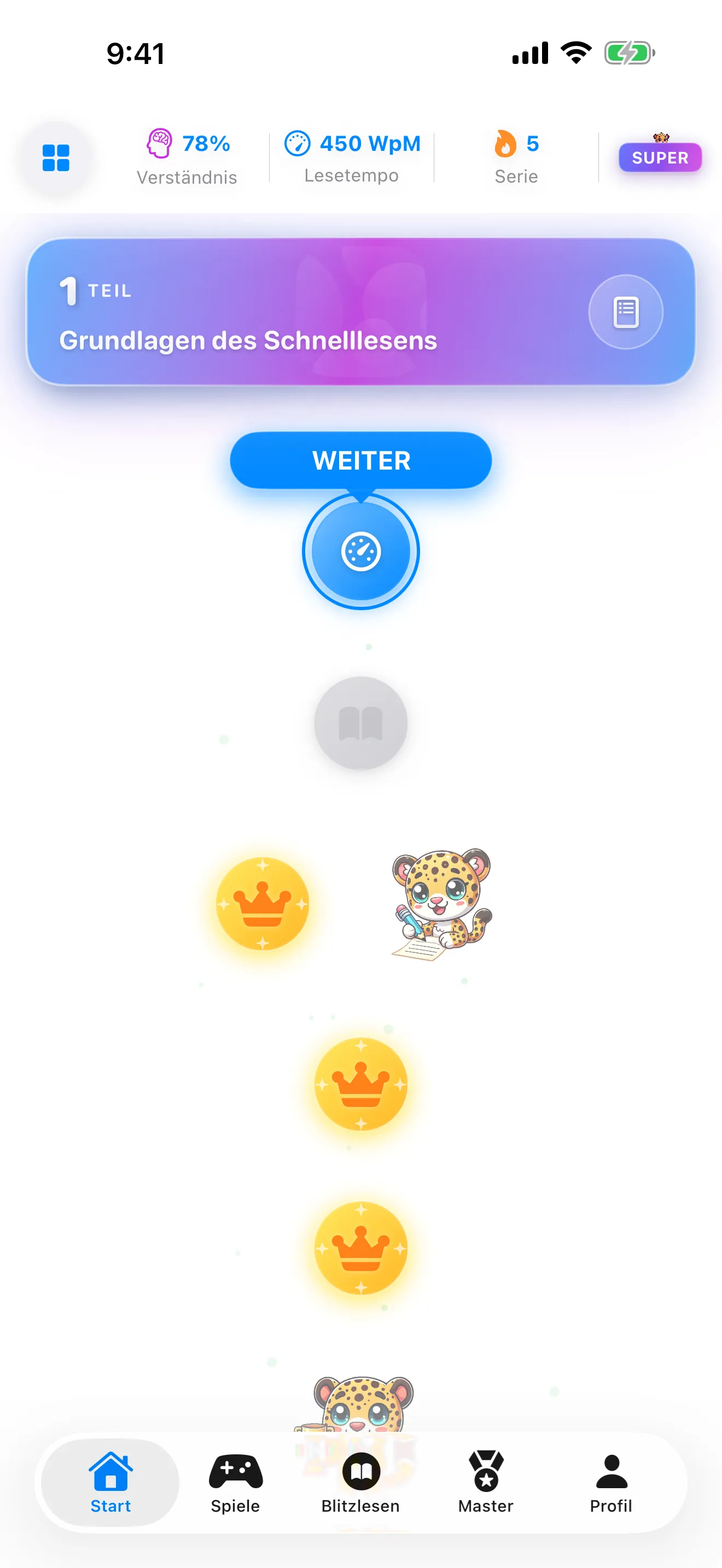
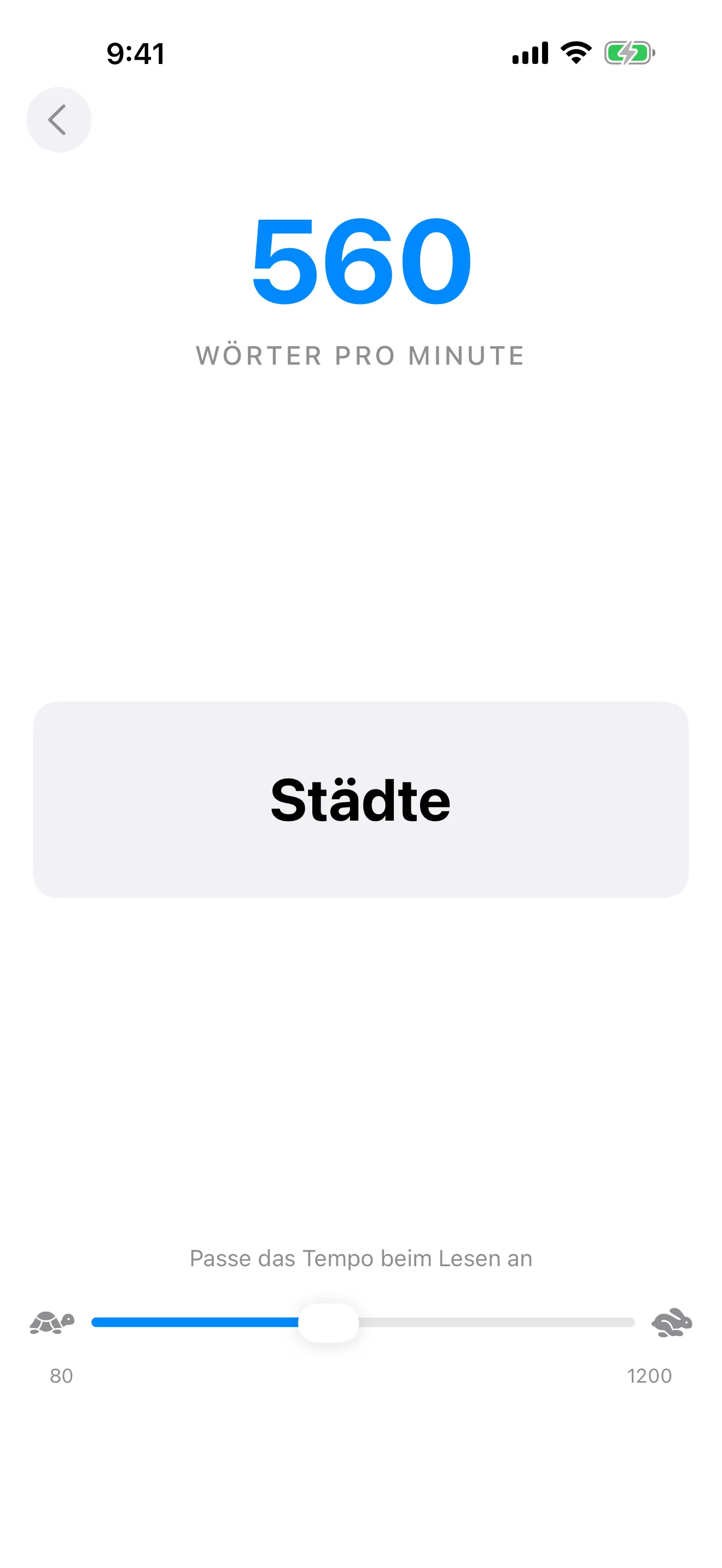
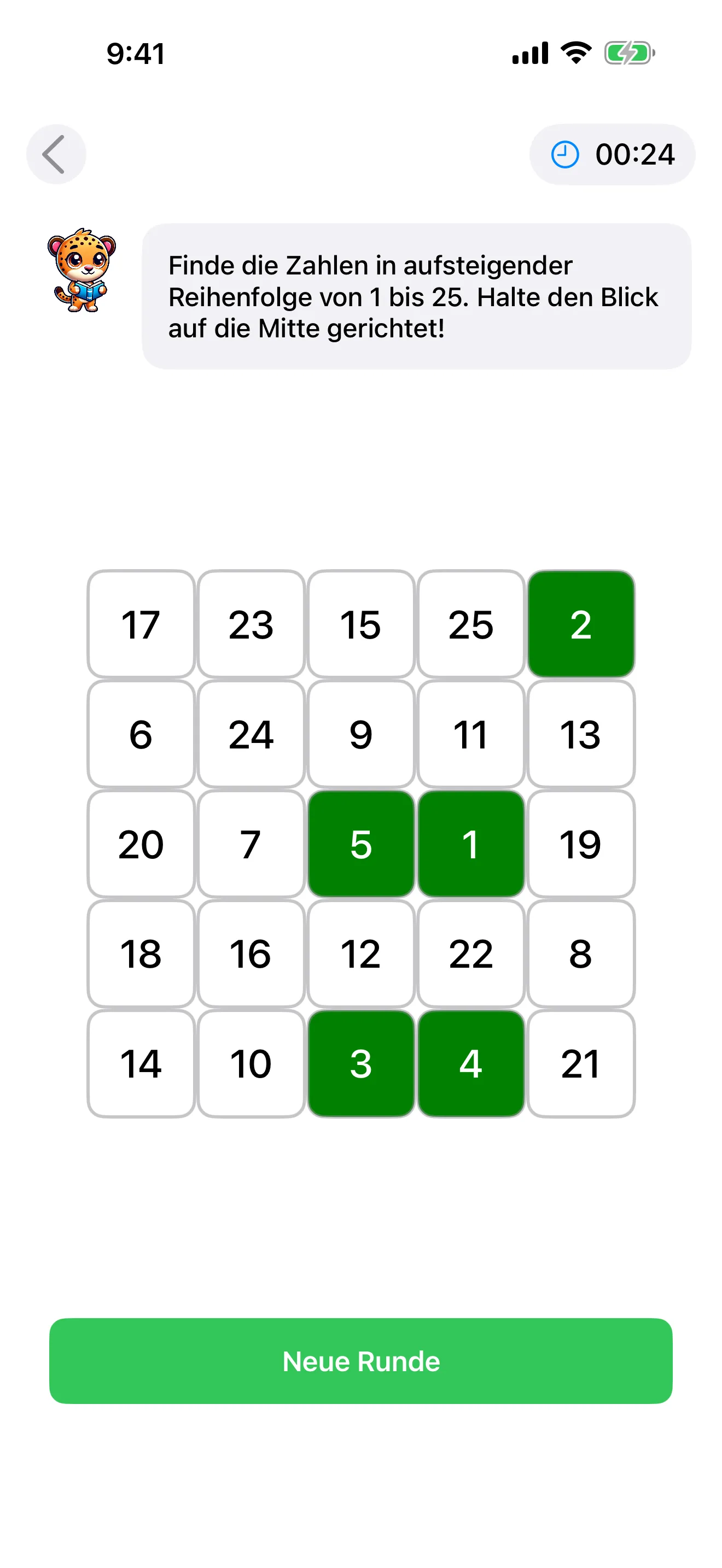
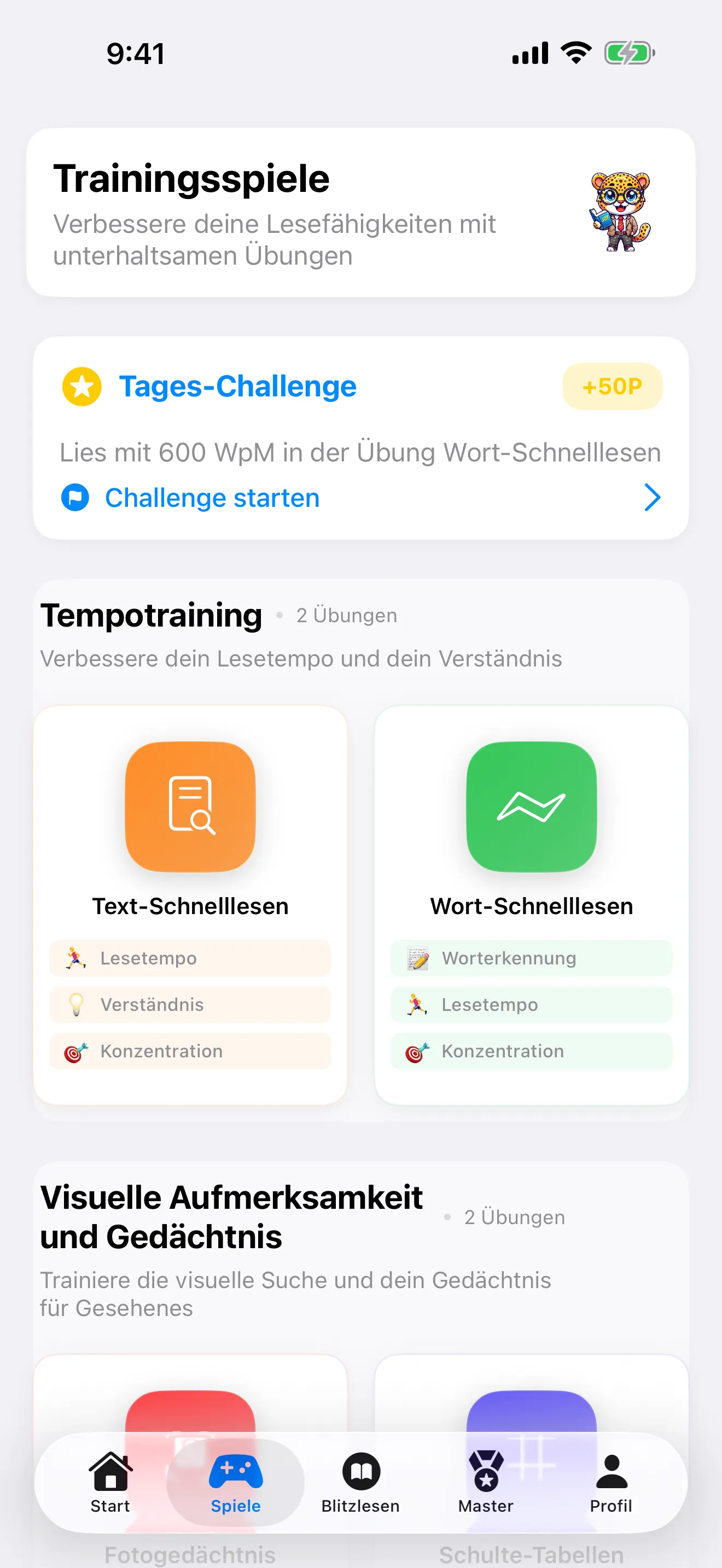
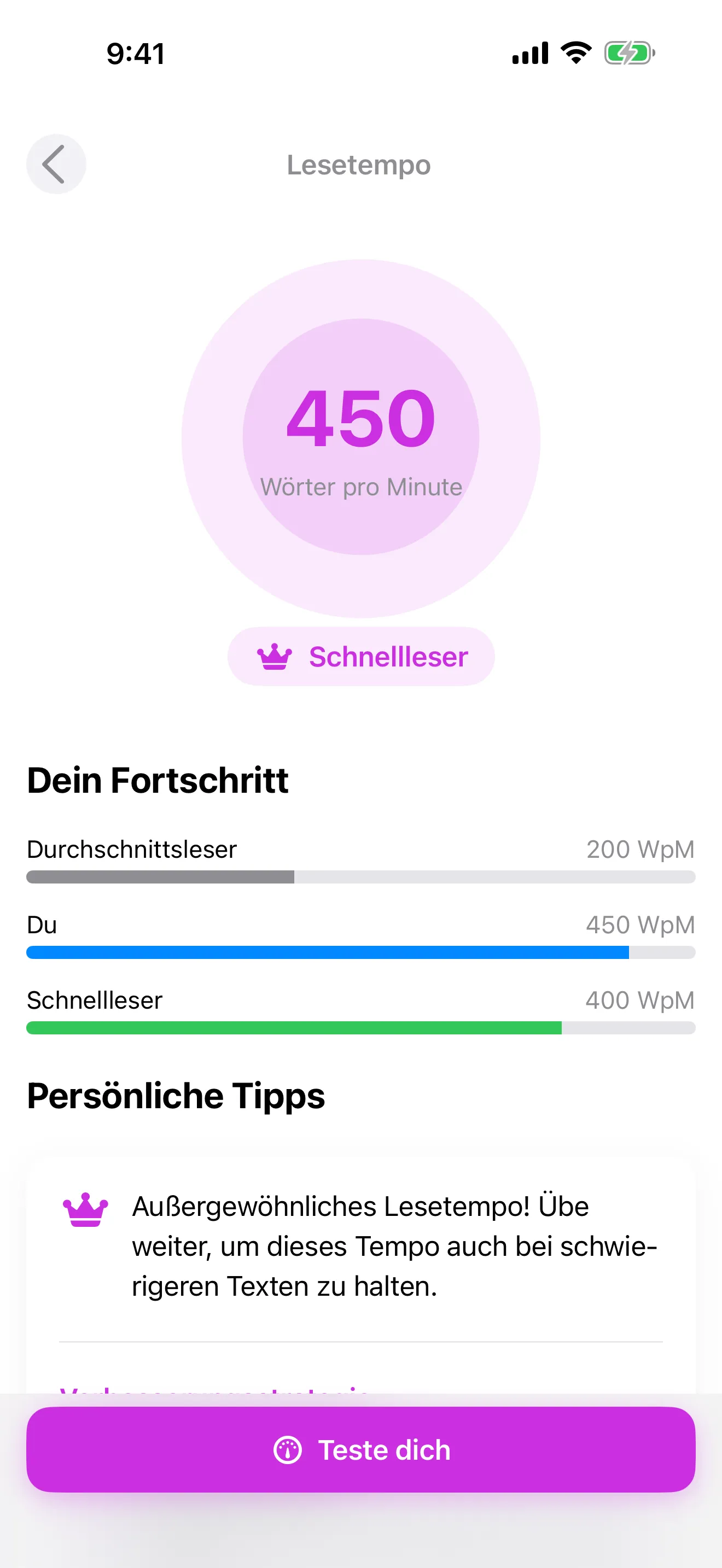
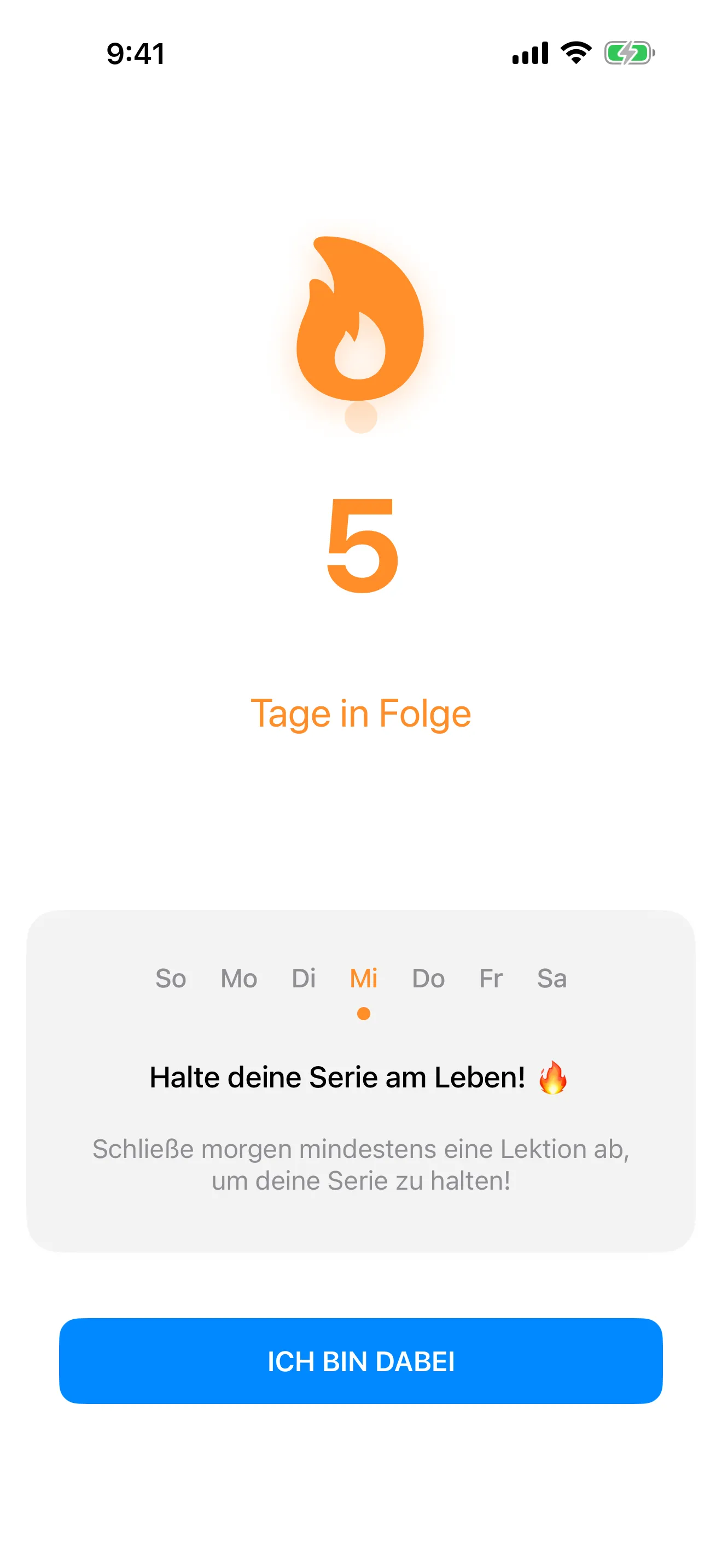
Die App macht aus der Methode eine tägliche Routine: ein Lernpfad, RSVP-Übungen bis 1.200 Wörter pro Minute, Schulte-Tabellen, Gedächtnisspiele und eine tägliche Serie. Sie ist kostenlos, mit einem optionalen Premium-Abo in der App.
Im App Store trägt sie je nach Land einen anderen Namen, in der Schweiz etwa „RSVP Reader: Schnell lesen“; auf dem Homescreen heißt sie einfach Speed Readingo.
Der Autor

Abdullah Yılmaz · Speed-Reading-Trainer · Gründer von Fastemy
Abdullah Yılmaz hat Speed Readingo entwickelt und unterrichtet Schnelllesen und Gedächtnistechniken. Sein türkischsprachiger Udemy-Kurs hat seit 2018 mehr als 49.000 Teilnehmende erreicht, mit 4,6 Sternen aus über 10.500 Bewertungen. Die Lektionen auf dieser Website folgen derselben Methode, angepasst für das Web und die App.
Schnelllese-Techniken & Gedächtnis: Lernen wie ein Genie (49.126 · 4,6★ · 10.519) · fastemy.com · LinkedIn · X · YouTube
Die Methode
Die Lektionen folgen dem Kurs, den Abdullah Yılmaz seit 2018 unterrichtet: drei Schritte (Vorab-Überblick, mit den Augen lesen und Markieren), geübt in kurzen täglichen Einheiten. Jede Lektion verbindet die Methode mit dem, was die Forschung dazu sagt, auch dort, wo die Belege dünn sind.
Wie wir mit Zahlen umgehen
- Jede Zahl in Lektionen, Ratgebern und Tools stammt aus veröffentlichter Forschung oder einer offiziellen Quelle und wird auf der Seite mit untersuchter Gruppe und Jahr genannt.
- Wenn die Forschung einer verbreiteten Speed-Reading-Behauptung widerspricht, sagen wir das, auch wenn die Behauptung beliebt ist.
- Unser Lesegeschwindigkeit-Test zeigt das Verständnis neben dem Tempo und markiert Ergebnisse unter 70 % richtigen Antworten, denn Tempo ohne Verständnis ist Überfliegen.
- Deutsche Ergebnisse vergleichen wir nur mit Daten zu deutschsprachigen Lesenden: Derselbe Inhalt braucht in jeder Sprache unterschiedlich viele Wörter.
- Einen „Durchschnitt der Deutschen“ veröffentlichen wir nicht, weil keiner gemessen wurde.
Quellen, die wir zitieren
- Acartürk, C., Özkan, A., Pekçetin, T. N., Ormanoğlu, Z., & Kırkıcı, B. (2024). TURead: An eye movement dataset of Turkish reading. Behavior Research Methods, 56(3), 1793–1816.
- Acklin, D., & Papesh, M. H. (2017). Modern speed-reading apps do not foster reading comprehension. American Journal of Psychology, 130(2), 183–199.
- ACX (Audible) (2025). Narrate an audiobook: how long will my narrated audiobook be?. ACX Help Center.
- Association for Psychological Science (2016). Speed reading: report and commentary (Rayner et al., with D. A. Balota). psychologicalscience.org.
- Benedetto, S., Carbone, A., Pedrotti, M., Le Fevre, K., Bey, L. A. Y., & Baccino, T. (2015). Rapid serial visual presentation in reading: The case of Spritz. Computers in Human Behavior, 45, 352–358.
- Brysbaert, M. (2019). How many words do we read per minute? A review and meta-analysis of reading rate. Journal of Memory and Language, 109, 104047.
- Callender, A. A., & McDaniel, M. A. (2009). The limited benefits of rereading educational texts. Contemporary Educational Psychology, 34(1), 30–41.
- Carabba, F., Borsati, C., Fontana, G., Altieri, E., Vicovaro, M., & Battaglini, L. (2026). Probing the use of visual search as a tool to enhance reading speed. Attention, Perception, & Psychophysics, 88(7), 190.
- Carver, R. P. (1985). How good are some of the world’s best readers?. Reading Research Quarterly, 20(4), 389–419.
- Cepeda, N. J., Pashler, H., Vul, E., Wixted, J. T., & Rohrer, D. (2006). Distributed practice in verbal recall tasks: A review and quantitative synthesis. Psychological Bulletin, 132(3), 354–380.
- Cepeda, N. J., Vul, E., Rohrer, D., Wixted, J. T., & Pashler, H. (2008). Spacing effects in learning: A temporal ridgeline of optimal retention. Psychological Science, 19(11), 1095–1102.
- Clinton-Lisell, V. (2022). Listening ears or reading eyes: A meta-analysis of reading and listening comprehension comparisons. Review of Educational Research, 92(4), 543–582.
- Clinton-Lisell, V. (2023). Does reading while listening to text improve comprehension compared to reading only? A systematic review and meta-analysis. Educational Research: Theory and Practice, 34(3), 133–155.
- Coşkun, E. (2007). Lise öğrencilerinin okuma hızı ve anlama düzeyleri üzerine bir araştırma. Milli Eğitim, 172, 29–39.
- Dresler, M., Shirer, W. R., Konrad, B. N., et al. (2017). Mnemonic training reshapes brain networks to support superior memory. Neuron, 93(5), 1227–1235.
- Duggan, G. B., & Payne, S. J. (2009). Text skimming: The process and effectiveness of foraging through text under time pressure. Journal of Experimental Psychology: Applied, 15(3), 228–242.
- Dunlosky, J., Rawson, K. A., Marsh, E. J., Nathan, M. J., & Willingham, D. T. (2013). Improving students’ learning with effective learning techniques. Psychological Science in the Public Interest, 14(1), 4–58.
- Durukan, E. (2014). Metinlerin okunabilirlik düzeyleri ile öğrencilerin okuma becerileri arasındaki ilişki. Ana Dili Eğitimi Dergisi, 2(3).
- Erden, G., Kurdoğlu, F., & Uslu, R. (2002). İlköğretim okullarına devam eden Türk çocuklarının sınıf düzeylerine göre okuma hızı ve yazım hataları normlarının geliştirilmesi. Türk Psikiyatri Dergisi, 13(1), 5–13.
- Gordon, C. L., Lysecky, R., & Vahid, F. (2023). Less is more: Students skim lengthy online textbooks. IEEE Transactions on Education, 66(2), 123–129.
- Graves, M. F., et al. (1983). Effects of previewing difficult short stories on low ability junior high school students’ comprehension, recall, and attitudes. Reading Research Quarterly.
- Greenlees, I., Thelwell, R., & Holder, T. (2006). Examining the efficacy of the concentration grid exercise as a concentration enhancement exercise. Psychology of Sport and Exercise, 7(1), 29–39.
- HandWiki (n.d.). Schulte table. handwiki.org.
- Hoffman, J. V., & O’Neal, S. F. (1979). An investigation into the internal and external rate flexibility of proficient readers in relation to the difficulty level of the material. ERIC ED192288.
- Kasson, S. C. (2012). Which study method works best? A comparison of SOAR and SQ3R for text learning. Master’s thesis, University of Nebraska–Lincoln.
- King-Shepard, Q. W., Walker, J., Nokes-Malach, T. J., Carpenter, S. K., & Fraundorf, S. H. (2025). The effect of prequestions on learning: A multilevel meta-analysis. Educational Psychology Review, 37(4), 115.
- Kuperman, V., & Van Dyke, J. A. (2011). Effects of individual differences in verbal skills on eye-movement patterns during sentence reading. Journal of Memory and Language, 65(1), 42–73.
- Lu, A., Wang, D., He, S., Zhongcheng, Q., Zhang, W., & Li, Z. (2022). Attention mechanisms underlying dual-color digital visual search based on Schulte grid: An event-related potential study. Brain and Behavior, 12(2), e2471.
- McDaniel, M. A., Howard, D. C., & Einstein, G. O. (2009). The read-recite-review study strategy: Effective and portable. Psychological Science, 20(4), 516–522.
- McNamara, D. S. (2000). Preliminary analysis of PhotoReading. NASA Ames Research Center (report NAG2-1319).
- MEB (2026). Sınavla Öğrenci Alacak Ortaöğretim Kurumlarına İlişkin Merkezî Sınav Başvuru ve Uygulama Kılavuzu. Millî Eğitim Bakanlığı.
- Mol, S. E., & Bus, A. G. (2011). To read or not to read: A meta-analysis of print exposure from infancy to early adulthood. Psychological Bulletin, 137(2), 267–296.
- Murphy, D. H., Hoover, K. M., & Castel, A. D. (2023). The effect of video playback speed on learning and mind-wandering in younger and older adults. Memory.
- Murphy, D. H., Hoover, K. M., Agadzhanyan, K., Kuehn, J. C., & Castel, A. D. (2022). Learning in double time: The effect of lecture video speed on immediate and delayed comprehension. Applied Cognitive Psychology, 36(1), 69–82.
- ÖSYM (2026). YKS maratonunda ilk oturum sona erdi (TYT: 120 soru, 165 dakika). osym.gov.tr.
- ÖSYM (2026). 2026-YKS sıkça sorulan sorular. ÖSYM.
- ÖSYM (2026). 2026 KPSS Kılavuzu (Lisans). ÖSYM.
- Perrone-Bertolotti, M., et al. (2012). How silent is silent reading? Intracerebral evidence for top-down activation of temporal voice areas during reading. Journal of Neuroscience, 32(49), 17554–17562.
- Ponce, H. R., Mayer, R. E., & Méndez, E. E. (2022). Effects of learner-generated highlighting and instructor-provided highlighting on learning from text: A meta-analysis. Educational Psychology Review, 34(2), 989–1024.
- Rayner, K. (2009). Eye movements and attention in reading, scene perception, and visual search. Quarterly Journal of Experimental Psychology, 62(8), 1457–1506.
- Rayner, K., Schotter, E. R., Masson, M. E. J., Potter, M. C., & Treiman, R. (2016). So much to read, so little time: How do we read, and can speed reading help?. Psychological Science in the Public Interest, 17(1), 4–34.
- Recht, D. R., & Leslie, L. (1988). Effect of prior knowledge on good and poor readers’ memory of text. Journal of Educational Psychology.
- Robinson, F. P. (1946). Effective study (revised edition). Harper & Brothers, New York.
- Rogowsky, B. A., Calhoun, B. M., & Tallal, P. (2016). Does modality matter? The effects of reading, listening, and dual modality on comprehension. SAGE Open, 6(3).
- Schotter, E. R., Tran, R., & Rayner, K. (2014). Don’t believe what you read (only once): Comprehension is supported by regressions during reading. Psychological Science, 25(6), 1218–1226.
- Snyder, V. (1984). Effects of study techniques on developmental college students’ retention of textbook chapters. Conference paper, ERIC ED243363.
- Trauzettel-Klosinski, S., Dietz, K., & the IReST Study Group (2012). Standardized assessment of reading performance: The new International Reading Speed Texts IReST. Investigative Ophthalmology & Visual Science, 53(9), 5452–5461.
- Twomey, C., & Kroneisen, M. (2021). The effectiveness of the loci method as a mnemonic device: Meta-analysis. Quarterly Journal of Experimental Psychology, 74(8), 1317–1326.
- Varao Sousa, T. L., Carriere, J. S. A., & Smilek, D. (2013). The way we encounter reading material influences how frequently we mind wander. Frontiers in Psychology, 4, 892.
- Weinstein, Y., McDermott, K. B., & Roediger, H. L. (2010). A comparison of study strategies for passages: Rereading, answering questions, and generating questions. Journal of Experimental Psychology: Applied, 16(3), 308–316.
- Yalçın, A., Çeltik, S. E., & Altınok, Ş. (2017). Hukuk fakültesi öğrencilerinin hızlı okuma becerilerinin değerlendirilmesi. Ahi Evran Üniversitesi Kırşehir Eğitim Fakültesi Dergisi, 18(3), 100–114.
- Yang, C., Luo, L., Vadillo, M. A., Yu, R., & Shanks, D. R. (2021). Testing (quizzing) boosts classroom learning: A systematic and meta-analytic review. Psychological Bulletin, 147(4), 399–435.
- Yıldırım, K., Rasinski, T., & Kaya, D. (2017). Fluency and comprehension of expository texts in Turkish students in grades four through eight. Eğitim ve Bilim, 42(192), 87–98.
Kontakt
Einen Fehler oder eine bessere Quelle gefunden? Schreib an contact@fastemy.com